“We’re replacing the floors but keeping the kitchen cabinets, which are a honey-toned oak we installed about eight years ago. Every sample I bring home looks fine in the store and wrong once it’s next to the actual cabinets. I don’t know if I’m bad at picking colors or if there’s an actual method for this, because right now it feels like trial and error with an expensive error.”
There’s a method, and the reason showroom samples keep misleading you is that showrooms aren’t where the comparison that matters happens. Learning this comes down to identifying undertone before anything else, since undertone conflicts are what make a floor look wrong even when the shade seems close. Shade is how light or dark something is. Undertone is the underlying color bias, whether something leans warm with yellow or orange beneath it, or cool with blue or gray.
Your honey oak cabinets carry a strong warm, yellow-orange undertone, which immediately rules out a large share of what you’ll find in a showroom.
Key Takeaways
- Undertone matters more than shade. A floor several shades lighter or darker than your cabinets can still work. A floor with a conflicting undertone usually won’t.
- Identify your cabinet’s undertone before shopping. A plain white sheet of paper held against the cabinet reveals the bias more reliably than memory or lighting alone.
- Matching exactly often looks worse than contrasting. A floor that nearly matches cabinets without quite getting there reads as a mistake, while clear contrast reads as intentional.
- Test in your actual kitchen, not the showroom. Store lighting and your home’s lighting produce different results, sometimes dramatically different ones.
- Honey oak is the clearest example of a restrictive undertone. Strong warm cabinets narrow your flooring options more than neutral ones do.
How Do You Find Your Cabinet’s Undertone?
This is the step that determines everything else, and it takes about five minutes. Skipping it is why so many people end up cycling through samples for weeks, since without a named undertone you’re comparing colors with no way to explain why one looks off. Once you know whether your cabinets lean warm or cool, most of the shelf rules itself out.
Do the White Paper Test
Hold a plain sheet of white paper directly against your cabinet door in natural daylight. The paper gives your eye a true neutral reference, and whatever color bias shows up in the cabinet by comparison is the undertone you’re working with. Yellow or orange bias means warm. Blue, green, or gray bias means cool. Some cabinets read close to neutral, which gives you more flexibility than either extreme.
This works better than trying to judge undertone from memory or from a small paint chip, since the brain adjusts to colors it sees constantly and stops registering the bias on its own.
Common Cabinet Undertones and What They Mean
Most kitchens fall into one of four categories, and knowing which one you have tells you a lot before you look at a single sample. The breakdown below is what narrows a showroom full of options down to a handful worth testing.
- Honey and golden oak, common in homes built through the 1990s, carry a strong warm undertone. These cabinets clash hardest with cool grays and blue-leaning floors, since the contrast between warm cabinet and cool floor reads as a mismatch rather than a style choice.
- Cherry and mahogany lean warm as well, often with a reddish cast that narrows the field further, since floors with any pink or red undertone of their own can create an unpleasant doubling effect.
- White cabinets vary more than people expect. Warm white leans slightly yellow or cream, while cool white leans slightly blue or gray. Pure white is rare and tends to show undertone in adjacent materials more than in itself, which is why white cabinets are often easier to pair with flooring than colored wood cabinets are.
- Gray and gray-stained cabinets can lean warm (greige) or cool (true gray), and this distinction matters as much here as with honey oak, just in the opposite direction.
Should the Floor Match or Contrast the Cabinets?
Contrast, in most cases, and this surprises people who assume matching is the goal.
A floor that comes close to the cabinet color without quite achieving it tends to read as an error, since the small gap between near-identical tones draws attention. A floor with clear separation in value, meaningfully lighter or meaningfully darker, reads as a deliberate design decision instead.
The undertones still need to agree even when the shades contrast. A dark floor and light cabinets can look intentional and considered, or they can look wrong, and the difference usually comes down to whether both are warm, both are cool, or one of each.
What Floor Tones Work With Warm Cabinets Like Honey Oak?
Warm cabinets pair most reliably with floors that share that warm foundation.
- Warm mid-tone woods in the honey, caramel, or light walnut range maintain harmony without matching too closely
- Warm grays with a beige or taupe base, sometimes called greige, bridge between gray’s modern appeal and the cabinet’s warmth
- Deeper warm browns create contrast in value while keeping the undertone compatible
- Avoid cool, blue-leaning grays, which are the most common mismatch with warm wood cabinets
- Avoid stark white or very cool-toned materials, which can make warm cabinets look dated or orange by comparison
- Multi-tone or variegated flooring gives you more flexibility than a single flat color, since it contains enough variation to relate to a range of adjacent tones, which is part of why natural wood look flooring with embossed grain patterns tends to pair more forgivingly than a flat, uniform surface
What If You Want Gray Flooring With Warm Cabinets Anyway?
Possible, but it requires choosing specifically within gray’s warm end rather than any gray that appeals to you.
A warm gray or greige, rather than a true blue-gray, is what makes this pairing work. The undertone compatibility matters more here than the fact that one element is “gray” and the other is “wood,” since the category names don’t predict how two surfaces will read next to each other in person.
Reviewing gray flooring ideas with this specific undertone constraint in mind narrows the field usefully, since not every gray shown there will suit a warm-cabinet kitchen.
How Do You Test Floor Samples Properly?
The showroom is close to useless for this decision, since its lighting has no relationship to your kitchen’s.
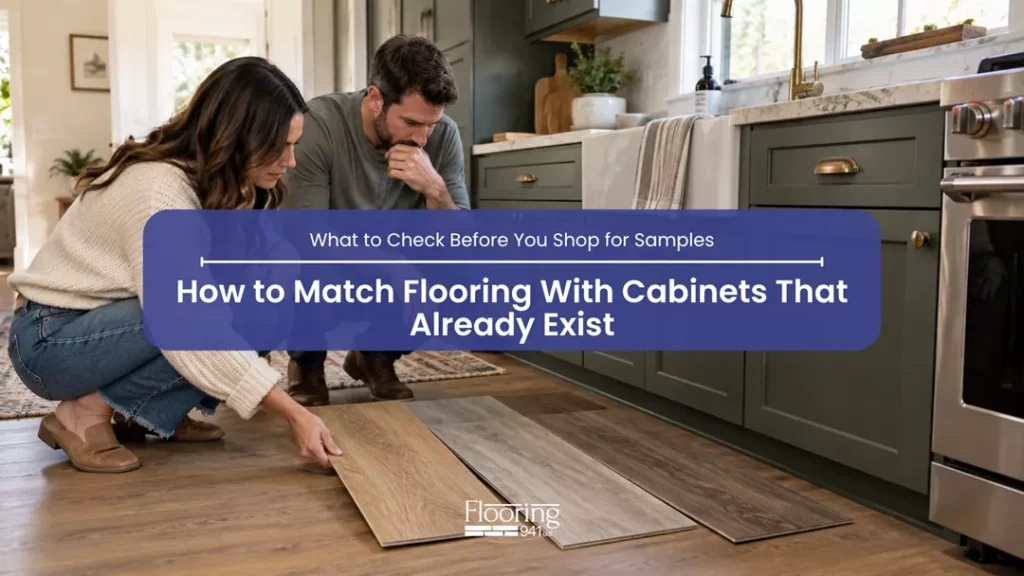
Bring full-size samples home rather than small chips, since color reads differently at scale. Lay them flat against the cabinet base rather than holding them upright, since that’s the actual visual relationship you’re evaluating. Check them in morning light, afternoon light, and under your kitchen’s evening fixtures, since daylight and artificial light render color differently and Florida’s strong afternoon sun shifts things further still.
Live with your top two or three choices for several days before deciding. First impressions in a five-minute test often shift once you’ve seen a sample across different times of day.
Does This Change With Dark Cabinets?
The principle stays the same, though the specifics shift. Dark cabinets, espresso or black finishes in particular, tend to read as closer to neutral in undertone than people expect, since very dark colors mute the visible bias. This gives you more flexibility than a mid-tone warm cabinet does, since there’s less undertone to conflict with.
The main consideration with dark cabinets becomes value contrast rather than undertone matching specifically, since pairing dark cabinets with an equally dark floor can make a kitchen feel closed in, particularly without abundant natural light. The same contrast principle is covered from the floor’s side in dark wood flooring ideas, including how to keep a dark floor from reading as heavy.
What About Cabinets You’re Painting or Refinishing?
If cabinets are changing alongside the floor, the sequencing flips. Choosing flooring first and painting cabinets to suit it gives you far more flexibility than the reverse, since paint colors are nearly unlimited while flooring options are comparatively fixed.
This is only relevant if cabinets are genuinely part of the project. For cabinets staying as they are, which is the more common situation, the floor has to do the adapting.
Frequently Asked Questions
Can I match flooring to cabinets using a photo?
Photos shift color meaningfully depending on the camera, lighting, and screen displaying them. Useful for narrowing a shortlist, not reliable for a final decision.
What if my cabinets have multiple tones, like an island different from the perimeter?
Match to whichever is more dominant in the space, usually the perimeter cabinets, and treat the island as an accent that can contrast more freely with both the floor and the main cabinetry.
Does cabinet hardware color affect this?
Less directly than the cabinet color itself, though warm metals like brass tend to reinforce a warm palette, while cool metals like chrome or brushed nickel suit a cooler one.
Is there a safe neutral that works with almost any cabinet?
Mid-tone, slightly warm neutrals come closest to universal, since true neutrals are rare and most “neutral” flooring still carries a subtle warm or cool lean worth checking.
Should I bring a cabinet door sample to the flooring store?
Yes, if a door or drawer face is removable, bringing it along is more reliable than trying to describe or photograph the color accurately.
Letting the Cabinets Set the Terms
How to match flooring with cabinets you’re keeping comes down to identifying undertone before shopping, choosing contrast over a near-match, and testing samples in your own kitchen rather than trusting a showroom. Honey oak and other warm-toned cabinets narrow the field toward warm or warm-neutral flooring, and stepping outside that range is where most mismatches happen.
Walking in with your cabinet’s undertone already identified turns a long, frustrating search into a much shorter one.