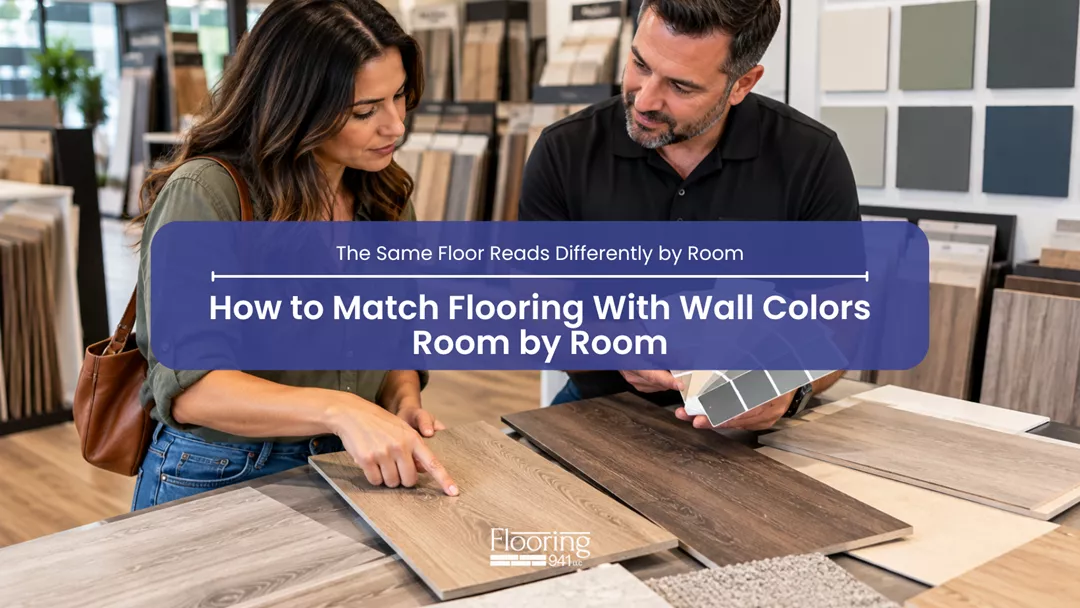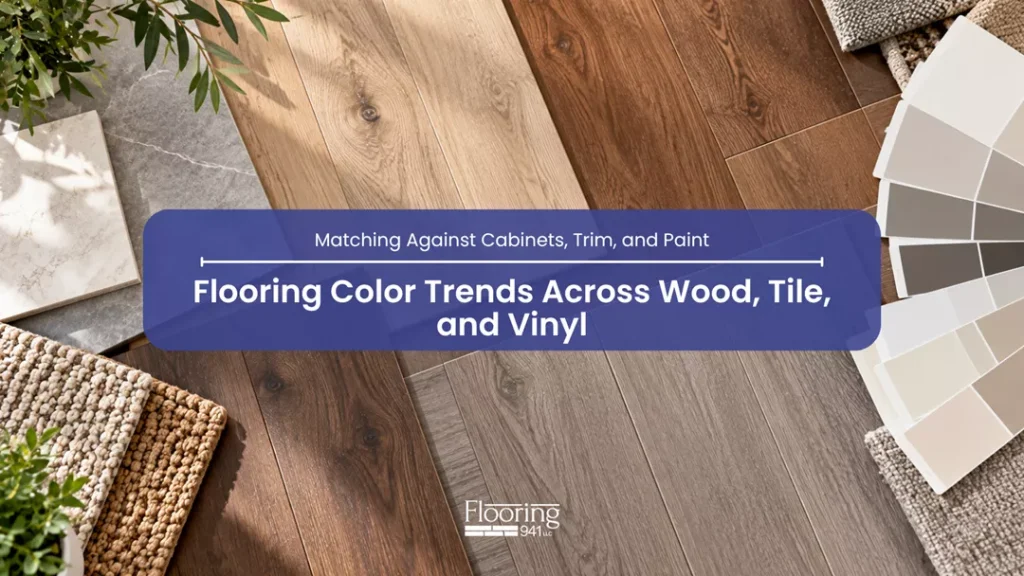
“We’re replacing the floors but keeping the kitchen cabinets, the trim, and the wall color. Every sample I bring home looks fine on its own and then looks wrong once it’s sitting next to the cabinets. I don’t want to end up in a situation where the new floor technically looks nice but forces us into repainting the whole house to make it work.”
That’s a real risk, and it comes from choosing the floor as if it’s entering an empty room. It isn’t. Knowing how to choose flooring color in a partial renovation means working backward from the elements already locked in, because those are the constraints doing most of the deciding. Your cabinets, trim, countertops, and existing paint have already narrowed the viable range considerably, and the job is to identify that range before you start falling for samples outside it.
Key Takeaways
- Inventory what’s staying before you shop. Cabinets, trim, counters, and fixed tile set the constraints you’re choosing within.
- Undertone matters more than shade. A floor two shades lighter than your cabinets will look fine. A floor with a clashing undertone won’t, regardless of how close the shade is.
- Matching exactly tends to look worse than relating. A floor that nearly matches cabinets reads as a failed match, while a clear difference reads as intentional.
- Cabinets usually carry the most weight. They’re the largest fixed color mass in most homes and the hardest element to work against.
- Test samples against the fixed elements, not on their own. Lay them directly against cabinet doors and trim, in that room, at multiple times of day.
What Should You Inventory Before Choosing a Flooring Color?
Everything staying in place contributes color information to the room, and a surprising number of these get overlooked until the floor is already installed.
- Kitchen and bathroom cabinets, which typically represent the largest single block of fixed color in the house
- Trim, baseboards, and door casings, since they border the floor directly and any undertone clash shows at that seam
- Countertops and backsplash, particularly natural stone with strong veining that carries its own undertone
- Fixed tile you’re keeping, including shower surrounds, fireplace faces, and backsplashes
- Interior doors, which are easy to forget but occupy real visual space in hallways and bedrooms
- Wall paint in connected rooms, not just the room being floored, since sightlines carry color across openings
- Built-in shelving or cabinetry, which functions as fixed color the same way kitchen cabinets do
- Large furniture you aren’t replacing, especially upholstered pieces and wood tables that anchor a room
- Stair treads or railings that connect to the floored area and need to relate visually
Writing this list down before you visit a showroom changes how you shop. It turns how to choose flooring color from an open-ended decision into a narrower matching problem, which is considerably easier to solve.
Why Does Flooring Color Undertone Matter More Than Shade?
This is the part most partial renovations get wrong. Shade refers to how light or dark something is. Undertone refers to the subtle color bias underneath, whether a surface leans warm, with yellow, red, or orange beneath it, or cool, with blue, green, or gray.
A floor noticeably lighter or darker than your cabinets will read as a deliberate contrast and look fine. A floor with a conflicting undertone will look off even when the shade is nearly identical, because the eye picks up the mismatch between a yellow-based oak cabinet and a gray-based floor plank immediately. The practical test is to hold a sample directly against the cabinet door. If one makes the other look dingy, muddy, or oddly pink, you’ve found an undertone conflict rather than a shade problem.
Honey oak cabinets, common in homes built through the 1990s, are the clearest example. They carry a strong yellow-orange undertone, which means a cool gray floor placed beside them tends to make the cabinets look more orange than they did before. The considerations covered in gray flooring ideas become especially relevant here, since warm-leaning grays handle this pairing far better than blue-leaning ones.
Should the Floor Match or Contrast the Cabinets?
Contrast, in almost every case. A floor that comes close to matching your cabinets without quite getting there reads as a failed attempt, and the small gap draws more attention than a large one would. A clear difference in value, meaning noticeably lighter or noticeably darker, reads as a deliberate design choice.
The exception is when you want the room to feel larger and more continuous, where keeping floor and cabinets in a similar tonal family can reduce visual breaks. Even then, the undertones need to agree, since similar shades with conflicting undertones produce the worst result of any combination.
How Do You Test Flooring Samples Properly?
The showroom is the least useful place to make this decision, since its lighting bears no resemblance to your home.
- Bring full-size samples home, not small chips, since color reads differently at scale
- Lay them flat on the existing floor, in the actual room, rather than holding them up vertically
- Push them directly against cabinet bases and trim so you’re seeing the junction you’ll live with
- Look at them in morning light, afternoon light, and under your evening fixtures, since Florida afternoon sun shifts color noticeably
- View them from a standing height, not crouched down, since that’s how you’ll normally see the floor
- Leave them in place for several days rather than deciding in one sitting, since first impressions often shift
- Check them in connected rooms too, where light conditions and wall colors differ from the primary space
Narrowing to two or three finalists and living with them for a week catches problems that a showroom visit never will.
What If Nothing Works With What You’re Keeping?
Occasionally the fixed elements are genuinely restrictive, usually when cabinets have a strong, unusual undertone. Reddish cherry, orange-leaning maple, and some older oak stains all fall into this category, since they sit far enough from neutral that most floors will either clash with them or amplify the very quality the homeowner dislikes about them.
At that point you have three options: accept a narrower range of floors than you’d hoped for, budget for refinishing or painting the cabinets, or choose a floor with enough visual texture and variation that it reads as neutral rather than committing to a single competing tone. Multi-tone and varied-plank options are genuinely useful here, and the realism improvements discussed in our article answering “what is luxury vinyl?” have made that third route far more viable than it used to be.
Does This Change by Room?
Somewhat. Living areas give you the most latitude, since there are typically fewer fixed color elements competing. The practical considerations in choosing the best flooring for living rooms in Florida matter alongside color in those spaces. Kitchens and bathrooms are the most constrained, since cabinets, counters, and tile stack multiple fixed elements into a small area. Bedrooms and hallways sit in between, with trim and doors as the main constraints.
Keeping flooring consistent across connected spaces generally produces a better result than optimizing each room independently, since transitions between different floor colors tend to chop up sightlines in a way that makes a home feel smaller.
Frequently Asked Questions
Can I just pick a neutral floor and avoid the problem?
Neutral helps but doesn’t eliminate the issue, since neutrals still carry undertones. A warm beige and a cool greige are both neutral and will behave very differently against the same set of cabinets.
How do I figure out my cabinets’ undertone?
Hold a sheet of plain white paper against them. The white gives your eye a true reference point, and whatever bias shows up in the cabinet by comparison, yellow, red, or gray, is the undertone you’re working with.
Should I pick the floor before or after repainting walls?
Floor first, if you’re doing both. Paint is available in essentially unlimited colors and can be matched to anything, while flooring options are far more limited. Choosing the harder-to-match element first is the more practical sequence.
Do current color trends matter here, or just matching?
Both, with matching taking priority. A trend-correct floor that fights your cabinets is a worse outcome than a slightly less current floor that works. Reviewing flooring color trends helps you understand your options, but your fixed elements still set the boundaries.
What if my trim is white and my cabinets are wood?
That’s a common and workable combination. White trim is close to neutral and gives you flexibility, so the cabinets become your primary reference point for undertone.
Letting the Room Make the Decision
How to choose flooring color in a partial renovation isn’t really an open question. The cabinets, trim, counters, and paint you’re keeping have already narrowed the field, and the work is identifying that range rather than browsing without constraints. Undertone agreement matters more than shade proximity, clear contrast usually beats near-matching, and testing against the actual fixed elements in your own light is what separates a good result from an expensive mistake.
For help narrowing material options once you know the tonal range you’re working within, our hardwood flooring species guide covers which species naturally fall where on the warm-to-cool spectrum.
Bring Your Constraints. Let Flooring 941 Bring the Samples.
Flooring 941 can bring samples directly to your home so you can compare them against your existing cabinets, trim, and lighting before committing to anything.
Call (941) 462-5316 or contact us for a free on-site estimate.